
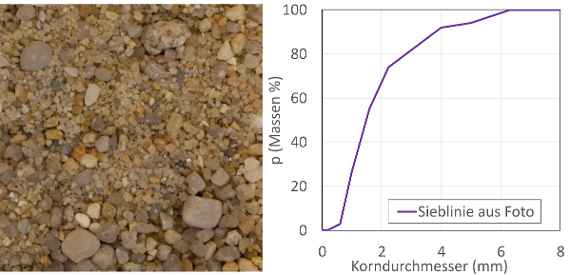
Project motivation:
Currently, accurately determining the grain size distribution of a particular area of the riverbed in laboratory experiments always involves damaging the surface (taking samples for sieve analysis). The new software is intended to enable the temporal development of grain sorting processes to be recorded across several experimental phases. Findings on grain sorting are used in conjunction with flow depths and flow velocities to assess riverine habitats. Furthermore, the temporal development of coarser surface layers in connection with riverbed stabilisation measures can be assessed.
As photographs are significantly easier and quicker to take than collecting bedload samples, it will be possible in future to analyse either larger areas of the riverbed with the same level of effort, or the same area with less effort.
Work planned:
Using existing artificial intelligence software modules for object and pattern recognition, a programme will be developed to determine the grain size distribution (sieve curve) from photographs of the bed of morphological model experiments.
Data sets (scale photographs plus associated sieve curves) will be created from sands available from hydro-morphological model experiments of our institute, for the training and validation of the software. Both individual grain fractions and various grain mixtures will be used. The individual grain fractions are obtained by sieving. The results of these sieving are also incorporated into the accuracy comparison and the determination of any necessary calibration parameters. Furthermore, tests are being carried out to determine whether specific image processing methods lead to improved results.
In addition to the software, a manual is being produced with detailed instructions on the procedure, starting with photographing the riverbeds through to the grain size distribution, including accuracy statements.
Client: Federal Ministry of Agriculture and Forestry, Climate and Environmental Protection, Regions and Water Management