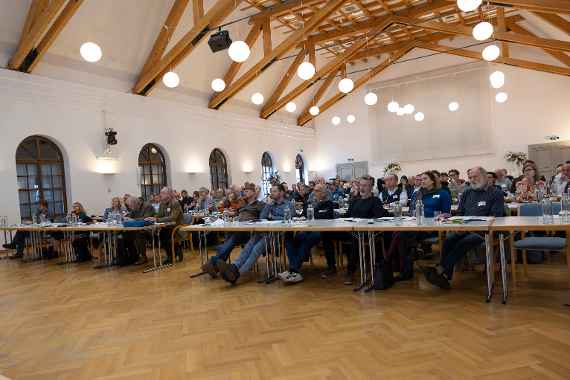
The Fisheries Conference 2025 of the Federal Office for Water Management (BAW), Institute of Aquatic Ecology and Fisheries Management (IGF), took place on 12 and 13 November at Mondsee Castle. The IGF is dedicated to two core themes in its work: fish as food, and the natural habitats in which fish occur. Since 1999, the institute has organised an annual specialist event that has become a fixed point in the calendar of Austria’s inland fisheries and aquaculture sector. In 2025, the conference once again brought together a broad range of participants – from former graduates of the vocational and master craftsperson courses to aquaculture operators, specialised veterinarians, aquatic ecologists, as well as representatives of conservation organisations and public authorities. The aim, as always, was to bridge the gap between the use and protection of fish stocks and to highlight current developments in science, practice, administration, and law.
The thematic orientation is guided by Section 9 of the Federal Offices Act, which requires federal offices and agricultural federal institutions to align their tasks with the needs of agriculture, water management, natural hazard protection, rural development, nature conservation, sustainability, and food systems. How broad this mandate is in practice was demonstrated by institute director Daniela Achleitner. She spanned topics ranging from official responsibilities such as fish migration aids, waterbody status monitoring, lake assessment, and expert witness work, to participation in committees (including EMFAF, the special directive on pond area subsidies, guidelines on the quality element “fish”, and the Fish Database Austria), and ongoing research projects on topics such as breeding lines in aquaculture, animal welfare under suboptimal water conditions, sustainable fish stocking, climate change monitoring, and long-term lake studies.
The conference strongly reflected the global crises that have long arrived in water management practice: climate change and biodiversity loss. Both days began with presentations on climate change. Helmut Wedekind (Bavarian State Institute for Agriculture, Institute for Fisheries, Starnberg) showed that flow-through aquaculture systems in Bavaria face challenges very similar to those in Austria: water shortages, temperature increases and oxygen depletion, heavy rainfall and flooding with increased turbidity and nutrient inputs lead to production losses, disease outbreaks, and rising risks. He presented technical and operational adaptations – from shading and oxygen management to the increasing use of recirculating aquaculture systems – while also emphasising that high investment and operating costs, skilled labour shortages, and acceptance issues remain major obstacles.
On the water ecology day, Günter Blöschl (TU Wien) presented a status report on the impacts of climate change on Austria’s waters. He showed that air and water temperatures have been steadily rising for decades, that extreme events such as heavy rain and localised flooding are increasing, and that evaporation and flow regimes are changing. The consequences for aquatic ecology, water management, and flood protection are already noticeable today and will continue to intensify.
A thematic focus of the aquaculture day lay on animal welfare. Elias Lahnsteiner (BAW-IGF) presented experimental work on microplastics in fish as food. Controlled trials detected microplastic particles in blood, head kidney and spleen, with indications of altered blood cell parameters, increased oxygen consumption, and potential liver damage. The results underline that microplastics are not merely an abstract environmental issue but raise concrete questions regarding animal health and food safety in aquaculture, highlighting the need for further research.
Under the title “Aspects of Fish Welfare in Focus: Animal Protection and Responsibility”, Eva Lewisch (Vetmeduni Vienna) addressed the question of what “fish welfare” technically means in aquaculture as well as regarding the stocking of natural waters. Lewisch outlined fundamental considerations on pain, suffering, and stress in fish. She demonstrated that the anatomical, physiological, and behavioural prerequisites for pain perception in fish are met and can hardly be seriously disputed today. Indicators for fish welfare in aquaculture include environmental factors such as stocking density, water quality (temperature, nitrogen compounds, pH level, oxygen concentration, flow rate, etc.), and fish-related parameters such as growth, feed conversion, nutritional condition, mortality, behaviour, body shape, skin and fin condition, eyes, health status, and slaughter/killing findings. With respect to animal-welfare-oriented stocking, she referred to the “Replace–Reduce–Refine” principle and presented improvement approaches for hatchery-reared stocking fish, such as environmental enrichment to reduce stress and promote species-specific behaviour.
Katrina Eder (Centre of Expertise for Animal Welfare and Husbandry) built on this and reported on animal welfare regulations and their application in the slaughter of catfish and shrimp. She explained how the centre evaluates new procedures and equipment, which legal gaps exist for “exotic species” such as shrimp, and how practical, welfare-compliant solutions are developed based on research projects (e.g., on hypothermia in shrimp). It became particularly clear that, for African catfish, no truly satisfactory standard method for humane slaughter currently exists, and further research and regulatory development are needed.
Franz Lahnsteiner (BAW-IGF) presented new methods for external and internal disinfection of salmonid eggs that can replace formalin and offer advantages both technically and environmentally.
The aquaculture day concluded with a report by Heistinger & Kiwek on a koi herpesvirus event in Vienna’s Alte Donau and the associated biosecurity and remediation measures – an example of how closely veterinary medicine, fisheries management, and waterbody administration must cooperate when things get serious.
The second day of the conference, the water ecology day, focused (in addition to the climate change talk) more strongly on the biodiversity crisis and fisheries management. Clemens Ratschan and Thomas Friedrich presented initial results of the update of Austria’s Red List of Fish. Their analyses showed that, although the overall balance of improvements and deteriorations in species threat levels since 2007 might appear even, many critical developments are evident in detail, often linked to pressures such as hydropower, climate change, stocking, and invasive species.
With Jan Baer’s presentation on the effectiveness of whitefish stocking in Lake Constance, it became clear that traditional management instruments such as stocking may lose their effectiveness under changing ecological conditions and need to be reassessed economically.
Martin Müller, in turn, demonstrated using pike in Lake Millstatt as an example that targeted harvest and well-designed harvest slot regulations can help reconcile ecological objectives with fisheries and economic interests.
The final presentation, by Fritz Schiemer and Paul Meulenbroek, provided a look at the Vjosa River in Albania: a largely free-flowing wild river as a reference system for “good ecological status” and a source of optimism in times of the EU Restoration Regulation. The Vjosa was presented as a natural laboratory from which much can be learned for river restoration in Central Europe.
Overall, the Fisheries Conference 2025 successfully linked aquatic ecology and aquaculture, research and practice, animal welfare and resource use, national issues and international perspectives – not only in the presentations but also through the numerous discussions during the breaks and at the joint evening dinner at Mondsee Castle.